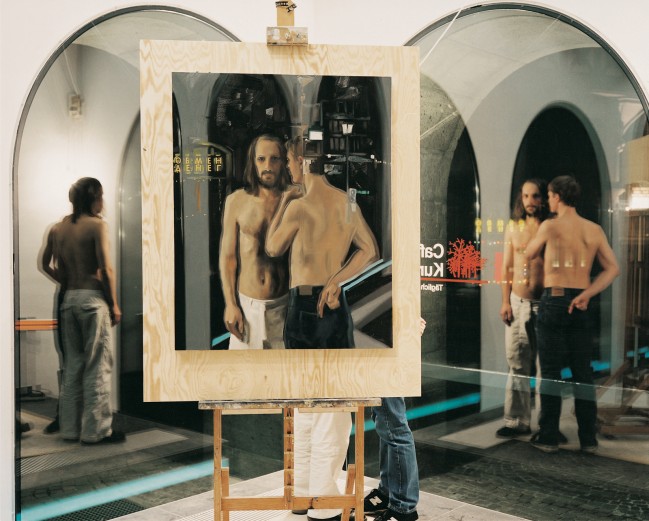
Frankfurter Judaskuss – Caroline von Grone

Frankfurter Judaskuss, 2003, Caroline von Grone, Arbeitsfoto (Foto: C. v. Grone)
Frankfurter Judaskuss © Caroline von Grone, Martin Kreyssig 2003

Frankfurter Judaskuss, 2003, Caroline von Grone, Videofilm / Länge: 15:00 min / Produktion: Caroline von Grone

Die Aktion Frankfurter Judaskuss findet zur Eröffnung der Ausstellung deutschemalereizweitausenddrei im Frankfurter Kunstverein im Jahr 2003 statt. Zwei männliche Halbakte stehen im Schaufenster des Kunstvereins Modell. Ihre Spiegelung im nächtlichen Fenster wird gemalt. Von außen ist fünf Tage vor der Eröffnung nur die Modellsituation sichtbar, nicht was gemalt wird, nach der Eröffnung erschließt sich von innen das Bildmotiv. Anschließend werden die entstandenen Bilder und der parallel in Zusammenarbeit mit Martin Kreyssig produzierte Film über die Aktion in der Ausstellung gezeigt.

The action Frankfurter Judaskuss (The kiss of Judas in Frankfurt) was performed to mark the opening of the exhibition deutschemalereizweitausenddrei at Frankfurter Kunstverein, Frankfurt am Main, 2003. Two male semi-nudes provided the models in the art association’s display window. Their reflection in the nocturnal window was painted. For five days before the opening, only the painter with the models could be seen from outside, not the painting; the subject of the painting only became apparent inside after the opening. Afterwards, the pictures painted were shown in the exhibition along with a film about the action filmed by Martin Kreyssig.

Produced with Martin Kreyssig, shown during the exhibition deutschemalereizweitausenddrei at Frankfurter Kunstverein, Frankfurt/Main, 2003

Text: Caroline von Grone

Referenz:
  1. von Grone, Caroline; Kern, Annette (2005): Frisch gestrichen: Caroline von Grone, Düsseldorf, 2005: Richter Verlag, S. 54f. [ISBN: 3-937572-41-4]
Frankfurter Judaskuss, 2003, Caroline von Grone, Screenshots aus dem Film von Martin Kreyssig
Frankfurter Judaskuss, Screenshots © Caroline von Grone, Martin Kreyssig 2003
Frankfurter Judaskuss, 2003, Caroline von Grone, Ausstellungsansicht (Foto: C. v. Grone), Film von Martin Kreyssig
Frankfurter Judaskuss, Ausstellungsansicht (Foto: C. v. Grone) © Caroline von Grone, Martin Kreyssig 2003

UW84DC – You Wait For The Sea – Richard Deacon

UW84DC © Richard Deacon, Gene Coleman, Martin Kreyssig 2001/2017

Film von Martin Kreyssig zur Ausstellung von Richard Deacon im Dundee Contemporary Arts, Dundee, 28 April – 24 June 2001. Länge: 11:27 Min, 2001 – 2017

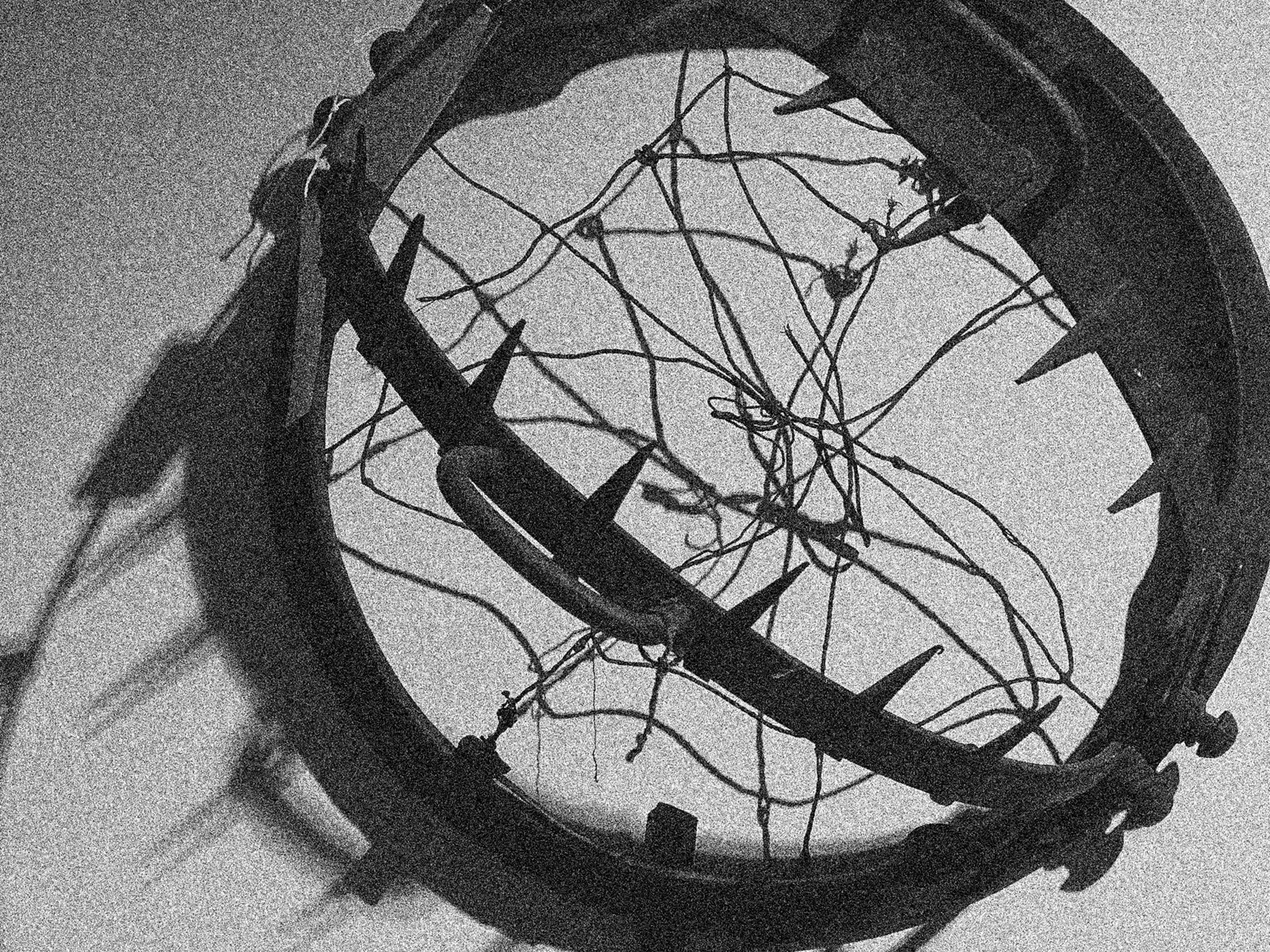
Der Musikfilm sammelt Bilder aus 15 Skulpturen von Richard Deacon und verbindet sie mit dem Musikstück „Phoenix4“ des amerikanischen Komponisten Gene Coleman.

»Richard Deacon is acknowledged as one of the principal British sculptors who has exhibited internationally since the early 1980’s. The Lisson Gallery is proud to announce the forthcoming exhibition including new large scale ceramic works and selections from the suite of steamed ash sculptures made for Deacon’s exhibition in Dundee last year.

Entitled, UW84DC, 2001 these fifteen lyrical wooden floor sculptures illustrate the historic interest Deacon has displayed throughout his career in joinery mixed with a light-hearted appreciation for the gesture. These unfurled and discarded remnants appear to belong to a larger whole yet somehow stand as constituent parts in their own right. Space is not contained within form, but rather form is composed and shaped by the dynamics of the structures themselves.

This corresponds and conflicts to form an interesting correlation with a new body of work of new large scale hand-built ceramic works that are inspired by the simple gestures of how the material reacts to methods of construction and manipulation, where hollowing, carving, piling and squashing become techniques in themselves. His dissatisfaction with the materials commonly associated with outdoor works drove him to explore the use of clay on a large scale, overcoming technical difficulties to produce a body of work that contradicts its materiality and scale. These highly finished forms allow for no procedural traces by which they are built, and in doing so become idealised forms where the appearance is divorced from the means of fabrication.

This preoccupation with methods of construction and uses of materials is one of continual development and the search for expressing new forms. The exhibition illustrates Deacon’s abiding fascination in the relationship between the physical and the material, however the work today is less overtly descriptive.«

(Quelle: http://www.lissongallery.com/exhibitions/richard-deacon)

Referenz:

1. Deacon, Richard; Bell, Vikki (2001): Richard Deacon: Sculpture, Dundee, Schottland: Dundee Contemporary Arts [ISBN: 0-9535178-6-1]

UW84DC © Richard Deacon, Gene Coleman, Martin Kreyssig 2001/2017

Unter Menschen 1 von x

Gesunken
Dringt kein Wort aus
Klammer Höhle
Stumpfe Dunkelheit der
Kälte toter Atem
Nebel roter Ziegelsteine
Klebrig stopfen Schleim und Dreck.

Unter Folienschwärze
Mahlen Lagen
Nasser Tücher Ballen dichten
Stoffs verstopfte Ohren
Klagen durchgebohrter Glieder
Kreischend flattern weiße
Schreie nicht Vogelflug nicht
Ausgerissene Gefieder
Auferstehung kleidet
Neu.

Unter Menschen 2 von x

Fordern schnelle
Fäuste Lärm und
Hohngelächter Scham verzerren
Mund und Nase blutig
Rohe Worte
Neid gezimmert
Haut und Knochen werfen
Wand und Rippen einen Schatten
Keine Lippen sanftes
Zucken aufgespannte
Haut dem Publikum zur
Trommel Abschied schlagen.

Raus aus der Manege
Blut und Rotz der
Kalte Boden
Reissen sie die Sehnen
Spielen sie die Lyra
Zu Schmerzen.

Das Figur-Grund-Problem in der Architektur des Barock (für dich allein bleibt nur das Grab) – Reinhard Mucha

Das Figur-Grund-Problem in der Architektur des Barock (für dich allein bleibt nur das Grab) © Reinhard Mucha, Martin Kreyssig 1985/86

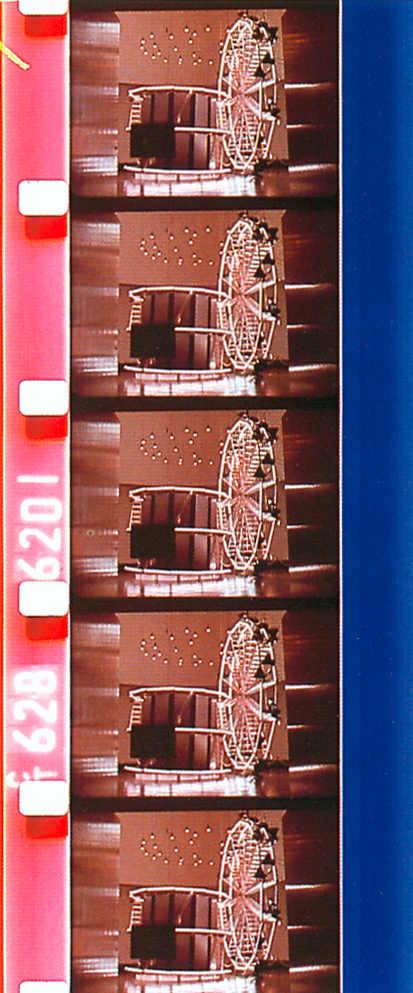
Der 16mm-Film (Länge 16:16 Min) dokumentiert eine Skulpur des Künstlers Rein­hard Mucha (*1950), die 1985 im Württembergischen Kunstverein in Stuttgart ausge­stellt wurde.

Die Tonspur besteht aus Ori­ginaltönen einer Steilwandfah­rershow auf der Düsseldorfer Rheinkirmes. Der gesprochene Text und die Geräusche der Motor­räder strukturie­ren den Film und setzen die künstlerische Arbeit in den von Rein­hard Mucha angeführten Kontext: „Fahrendes Volk“, „Kunst auf Rä­dern“ und „Ortlosigkeit der modernen Kunst“.

Referenzen:
  1. Mucha, Reinhard; Osterwold, Tilman; Kraft, Monika Maria (1985): Das Figur-Grund Problem in der Kunst des Barock (für dich allein bleibt nur das Grab), Württembergischer Kunstverein, Stuttgart, Deutschland
  2. Gaensheimer, Susanne; Wolf, Frank (2022): Der Mucha: Ein Anfangsverdacht, Düsseldorf, Deutschland: Hirmer Verlag, S. 103-114, 286 [ISBN: 978-3-941773-65-3]
Das Figur-Grund-Problem in der Architektur des Barock (für dich allein ist nur das Grab) / Screenshot © Reinhard Mucha, Martin Kreyßig 1985/86
Das Figur-Grund-Problem in der Architektur des Barock (für dich allein ist nur das Grab) / 16mm Filmstreifen © Reinhard Mucha, Martin Kreyßig 1985/86
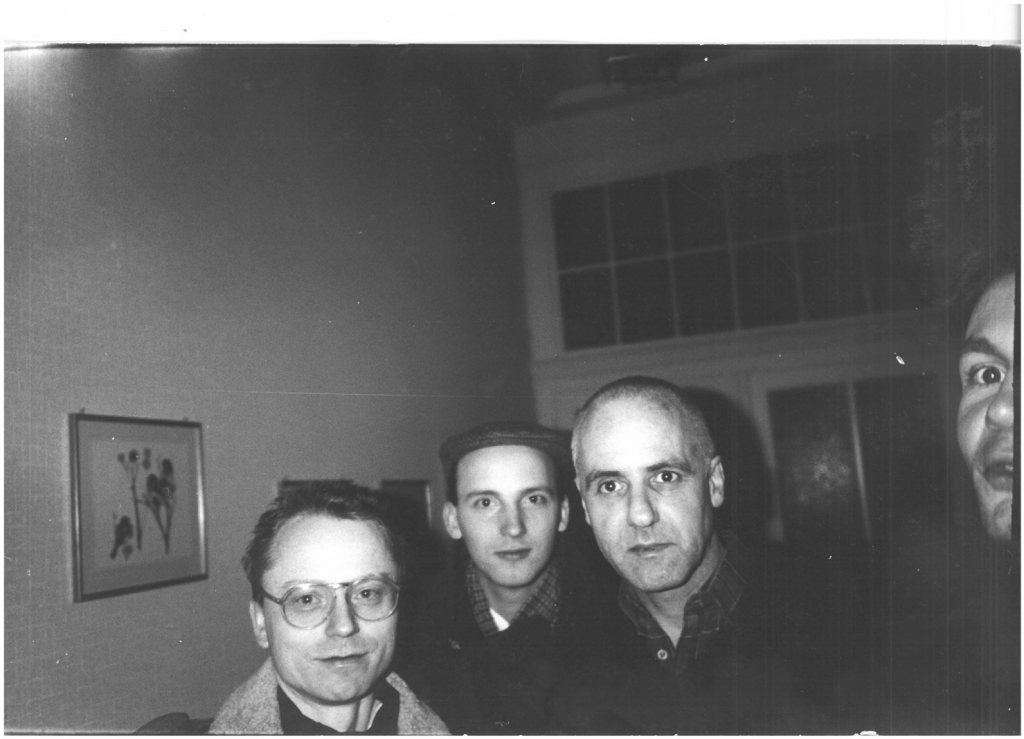
(v.li.n.re) Reinhard Mucha, Martin Kreyssig, Jean-Christophe Ammann, Johannes Lenhart © Johannes Lenhart 1987