Film zur gleichnamigen Performance mit Gustav Kluge, Kathrin Haaßengier and Petra Kluge am 9.1.2009, anlässlich der Ausstellung „Zelle im Fluchtweg“ von Gustav Kluge im Hospitalhof Stuttgart vom 9. Januar 2009 bis 8. Februar 2009.
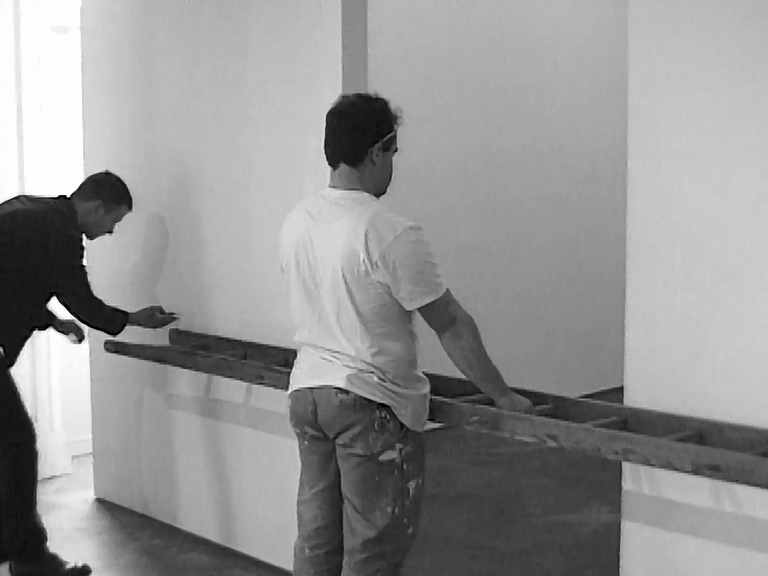
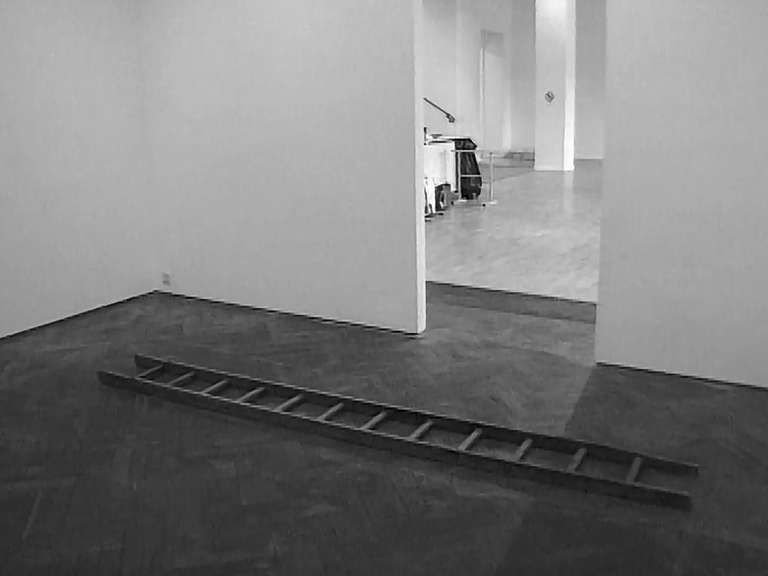
Eine Aktion von Andreas Slominski, der eine Holzleiter durch eine Tür trägt. Der Film konzentriert sich auf die Vor- und Nacharbeiten der Handwerker und bereitet so den Platz für die echten Gesichter, Handlungen und Fertigkeiten im Kunstgeschäft.
»German artist Andreas Slominski attempted to enter one room of the Casino Luxembourg with a ladder in a horizontal position. However, as the door was too narrow, outlines of the ladder were cut into the wall. Once the ladder was inside the room, the wall was repaired and a video of this process was projected serving as a reflection on the reception and production of the artistic process.«
Konzertportrait und Performance „Der Gefesselte / The Bound Man“ (basierend auf der gleichnamigen Erzählung von Ilse Aichinger, erschienen 1953) von und mit Peter Brötzmann (1941-2023) und Mike Pearson (1950-2022) im Westwerk, Hamburg. Fernsehbeitrag von Martin Kreyssig, produziert im Auftrag von Kultra, 3sat, 1992.
Der Gefesselte / The Bound Man / Mike Pearson und Peter Brötzmann, Plakat @ Westwerk 1992
Nicolas A. Baginsky / Barry Schwarz / Kampnagel, Hamburg 1995 / Videodokumentation / Länge: 17:23 Min / Produktion: Nicolas A. Baginsky „A 5-ton performance together with Barry Schwartz.“ Nicolas A. Baginsky
About the Project: »“I-Beam Music“ is a performance, that explores acoustic phenomena using old and new technologies. „I-Beam Music“ is an orchestrated sculpture, an installation, that deals equally inventive with water, high voltage, fire and chemicals as well as with machines, computers and sensors. „I-Beam Music“ is the tittle of a computer driven machine-performance developed by hamburgian sculptor Nicolas Anatol Baginsky in collaboration with the californian performance-artist Barry Schwartz.
The central element in this installation is a string instrument, the artists have build using a 4 meter long steel I-beam . During the performance, the six-string instrument undertakes an automatic journey through an environment 25 meters in length. Similar to the functional principle of a car-wash, the string instrument travels through different situations and is being played there in very different ways: mechanical fingers pick the strings, chemicals create tones, extreme heat and cold tune the instrument. Dry ice and liquid nitrogen as well as parts of an old photocopier play the strings. In a later section, the combination of water and high voltage generate electrifying sounds. On its travel, the instrument develops various characters. For example: it turns into a bottleneck-guitar, then it becomes a bowed string-instrument and towards the end it is a „industrial- music“ type sound generator. The artists also use related machinery and instruments to orchestrate the performance: a converted turntable mounted to an electro vehicle uses the motion momentum to generate music. A wheelbarrow is turned into a sound harp.
A computer program forms the acoustic environment for the performance. This program, written by Baginsky especially for this project, analyses in real-time all acoustic events in the performance space. The resulting data is then being interpreted and output via electronic instruments and robotic actuators. This mechanism engineers a recursive symphony based upon existing sound and music.
Several surveillance cameras inside the I-beam instrument and at various positions in the set allow endoscopic insight into the installation. The images are life-mixed by a computer and are then displayed by two video projectors.
Nicolas Anatol Baginsky and Barry Schwartz are both artists that, in their way of working, combine the artist, the engineer and the technician. What they have in common is an extraordinary attraction towards the graveyards of industrial society: containers filled with junk machinery. As a result to that strategy their biggest common divisor becomes visible: beautifully engineered machine music. A machine music that explores the extremes of music and technology.«
Andreas Slominski, Deutsche Guggenheim Berlin, 1998, Videofilm, Länge: 11:25 min Inhalt: Andreas Slominski stellt einen Eimer voll Wasser zwischen die Bücher und Regale des Museumsshops.
»Slominski stellte einen Eimer voll Wasser zwischen die Bücher und Regale des Museumsshops. Jedoch – der weiße Eimer war zunächst leer gewesen. Slominski beauftragte einen Klempner, eine Wasserleitung zu installieren. An der Rückwand der Toilette wurde die Hauptleitung freigelegt und Slominskis Rohre angeschlossen, an das Ende der Kupferrohre ein Wasserhahn montiert. Durch diese Leitung floß nun das Wasser in den Eimer. Nachdem sie ihre Aufgabe erfüllt hatte, wurde die Leitung wieder entfernt und das Loch in der Wand zugemauert. Nur eine einzige Spur ist geblieben: der Plastikeimer voll Wasser. Gibt es etwa ein Leck an der Decke?»
Eimer Wasser, Andreas Slominski @ Deutsche Guggenheim Berlin, Andreas Slominski, Martin Kreyssig 1998Eimer Wasser, Andreas Slominski @ Deutsche Guggenheim Berlin, Andreas Slominski, Martin Kreyssig 1998Eimer Wasser, Andreas Slominski @ Deutsche Guggenheim Berlin, Andreas Slominski, Martin Kreyssig 1998